In recognition of World Alzheimer’s Month
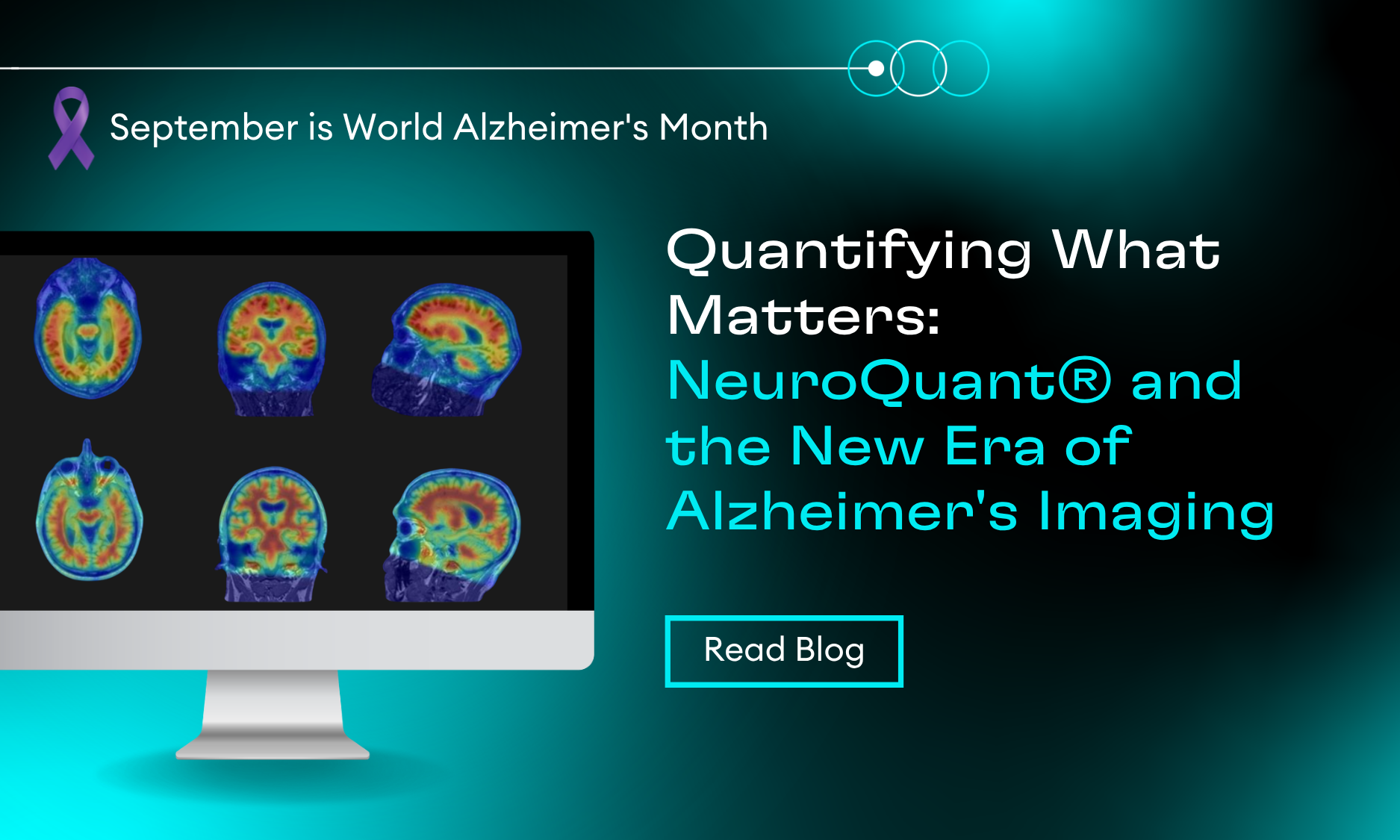
Every September, World Alzheimer’s Month asks the clinical community to look hard at where we are in the fight against dementia — and where we’re headed. For neurologists and neuroradiologists, the answer this year is unmistakable: Alzheimer’s disease has become a biomarker-defined condition, and imaging now sits at the center of how we diagnose it, treat it, and keep patients safe. At Cortechs.ai, we’ve spent this year expanding the NeuroQuant® platform to meet that moment — most recently with FDA clearance of NeuroQuant® PET, bringing objective, reproducible quantification to amyloid and metabolic brain imaging.
Alzheimer’s is now a biomarker diagnosis
The shift from phenotype to pathology is no longer aspirational. Amyloid-β pathology can begin accumulating in the brain a decade or more before the first memory complaint, and the arrival of anti-amyloid therapies has made confirming that pathology a prerequisite, not a formality. Amyloid PET is now routinely required before initiating agents like lecanemab and donanemab, and the interpretive burden that comes with it lands squarely on neuroradiology.
That burden is real. Visual reads of amyloid PET remain subjective, vary across institutions, and are difficult to reproduce over time — especially in settings without subspecialty-trained readers. Metabolic patterns on FDG-PET that distinguish Alzheimer’s from frontotemporal or Lewy body dementia can be subtle. And the anatomy is unforgiving. When treatment eligibility and safety decisions hinge on the read, “impression: consistent with” is increasingly being asked to carry more weight than a qualitative assessment alone can bear.
NeuroQuant® PET: FDA-cleared quantification for the amyloid era
On August 18, 2026, the FDA cleared NeuroQuant® PET (510(k) K261916), extending the NeuroQuant platform from structural MRI into molecular imaging. The tool automates brain PET analysis by segmenting anatomical regions from the patient’s own MRI, measuring tracer uptake within each region, and comparing those values against normative population data — turning a qualitative scan into standardized, defensible numbers.
For Alzheimer’s imaging specifically, that means two things neuroradiologists have been asking for:
- Standardized Uptake Value Ratios (SUVRs) and Centiloid quantification for amyloid PET, giving a normalized, cross-tracer scale that supports consistent thresholds and longitudinal comparison.
NeuroQuant PET supports the FDA approved amyloid tracers: florbetapir, florbetaben, and flutemetamol . It’s built to fit real reading environments: compatible with PET-CT, PET-MR, and PET-only acquisitions, fully automated, and delivering PACS-ready structured reports without adding manual steps to the workflow.
As Cortechs.ai CEO Kyle Frye put it, the goal is to give “clinicians objective, reproducible measurements they can trust, so patients get earlier answers.” In a disease where earlier answers change treatment eligibility, that reproducibility isn’t a convenience — it’s the point.
A complete Alzheimer’s imaging workflow — not a single tool
NeuroQuant PET doesn’t stand alone. It’s the newest piece of an imaging platform designed around the full Alzheimer’s care pathway, from early suspicion through active treatment monitoring.
Structural volumetrics. NeuroQuant’s foundation is automated, FDA-cleared volumetric MRI analysis — quantifying hippocampal and regional brain volumes against age- and sex-matched norms. Volume loss remains one of the earliest and most actionable structural signals in the neurodegenerative workup, and it provides essential anatomical context for interpreting molecular findings.
ARIA monitoring for anti-amyloid therapy. As patients start lecanemab and donanemab, amyloid-related imaging abnormalities (ARIA) become a central safety concern. With NeuroQuant® Lesion Surveillance, the platform supports deep-learning segmentation and quantification of both FLAIR and GRE/SWI lesions associated with ARIA. This gives care teams a consistent, quantitative way to track and monitor disease across the treatment course — the kind of standardized surveillance that infusion protocols increasingly demand.
Molecular confirmation. NeuroQuant PET closes the loop, adding amyloid and metabolic quantification that pairs directly with the same patient’s structural segmentation.
Taken together, the platform mirrors the way modern Alzheimer’s care actually unfolds: establish the structural baseline, confirm the pathology, initiate therapy, and monitor for safety — all on quantitative footing, all within one reporting environment.
Why quantification changes the read
For neuroradiologists, the value proposition is straightforward. Reproducible numbers reduce inter-reader variability, make longitudinal change measurable rather than impressionistic, and give referring neurologists a common language for treatment decisions. A Centiloid value or a hippocampal percentile travels across visits, across sites, and across the multidisciplinary team in a way a subjective descriptor cannot.
For neurologists, it means faster, better-supported eligibility and monitoring decisions — objective evidence of amyloid status before committing a patient to therapy, and quantitative ARIA tracking once they’re on it.
Marking World Alzheimer’s Month
The theme running through this year’s awareness effort is that early, accurate detection is the foundation of everything that follows in Alzheimer’s care. Quantitative imaging is how that foundation gets built. With NeuroQuant® PET now FDA-cleared alongside our structural and lesion surveillance solutions, Cortechs.ai is committed to giving the clinicians on the front lines of this disease the objective, reproducible tools the moment demands.
This World Alzheimer’s Month, the message is simple: we can see Alzheimer’s more clearly than ever — and we can finally measure what we see.
Learn more about NeuroQuant® PET and the full NeuroQuant platform at cortechs.ai. NeuroQuant® PET received FDA 510(k) clearance (K261916) on August 18, 2026.