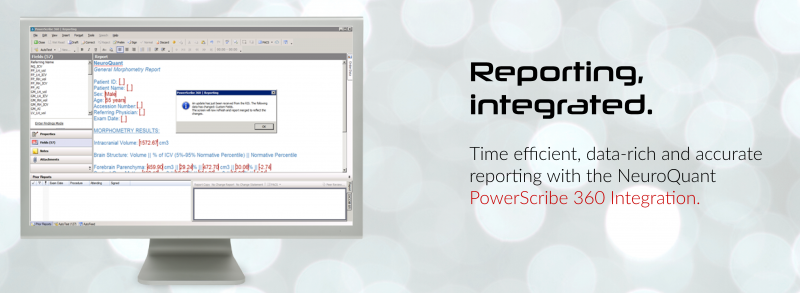
Did you know NeuroQuant is fully integrated with PowerScribe 360?
NeuroQuant’s volumetric reports can contain a lot of numerical data that must be transcribed by reviewing radiologists. Cortechs.ai has developed an integration for NeuroQuant with PowerScribe® 360, allowing radiologists to quickly and effortlessly pre-populate NeuroQuant and LesionQuant data into their radiology reports.
What is NeuroQuant®
NeuroQuant® is a leading medical device software which automatically labels, segments and quantifies the volume of brain structures from 3D volumetric MR scans. NeuroQuant reports provide quantitative data to supplement visual reads and help physicians in their assessment of neurological conditions, such as Alzheimer’s disease, multiple sclerosis, epilepsy, brain trauma, as well as brain development.
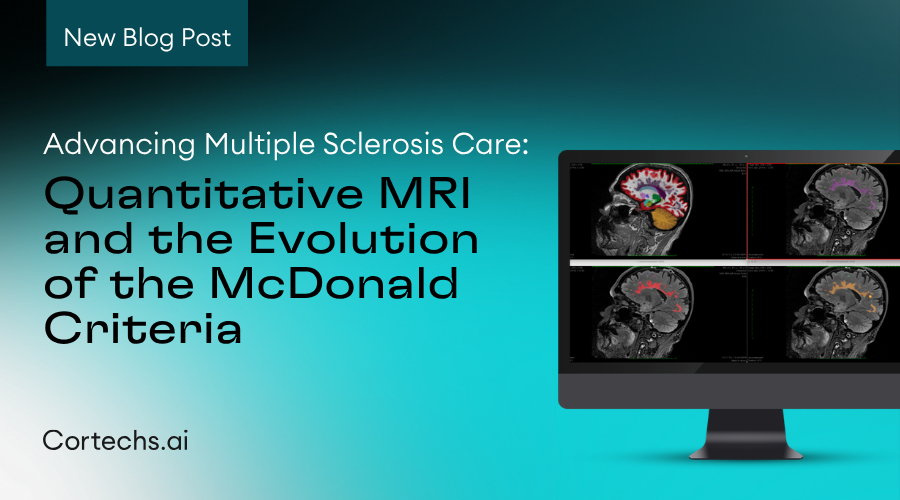
LesionQuant, a module within NeuroQuant, that combines T2 FLAIR with 3D T1 MR images to enhance physicians ability to identify and monitor the number and progression of brain lesions. Accurately visualizing lesions and lesion volume change enables physicians to deliver an efficient, objective assessment of disease activity.
Why is this important?
With the NeuroQuant and PowerScribe 360 integration physicians will:
- Receive pre-populated data in NeuroQuant Reports
- Reduce the likelihood of transcription errors
- Save time dictating NeuroQuant/LesionQuant Data
 What does this integration provide?
With the PowerScribe 360 integration, all NeuroQuant and LesionQuant volumetric and reference data are pre-populated into a PowerScribe 360 report template prior to dictation. This will eliminate the time-consuming dictation of numeric results, thereby streamlining report dictation and reducing the likelihood of transcription errors.
Additionally, customizable, flexible templating makes it possible for radiologists to quickly create reports that conform to institutional standards while reducing the dictation burden.
Who benefits from this integration?
Radiologists at hospitals, clinics, imaging and research centers worldwide can benefit from this expanded capability, resulting in more time-efficient, data-rich, and accurate reporting when reading NeuroQuant and LesionQuant results.
What are the system requirements?
PowerScribe 360 integration works with both cloud-based and locally installed NeuroQuant 3.0 systems.
- NeuroQuant PowerScribe 360 subscription license from Cortechs.ai
- CTXNode 2.2 or higher
- NeuroQuant 2.0 or higher
- PowerScribe 360
Want more information?
Learn more about NeuroQuant with PowerScribe 360 integration, subscription, and pricing by clicking below.