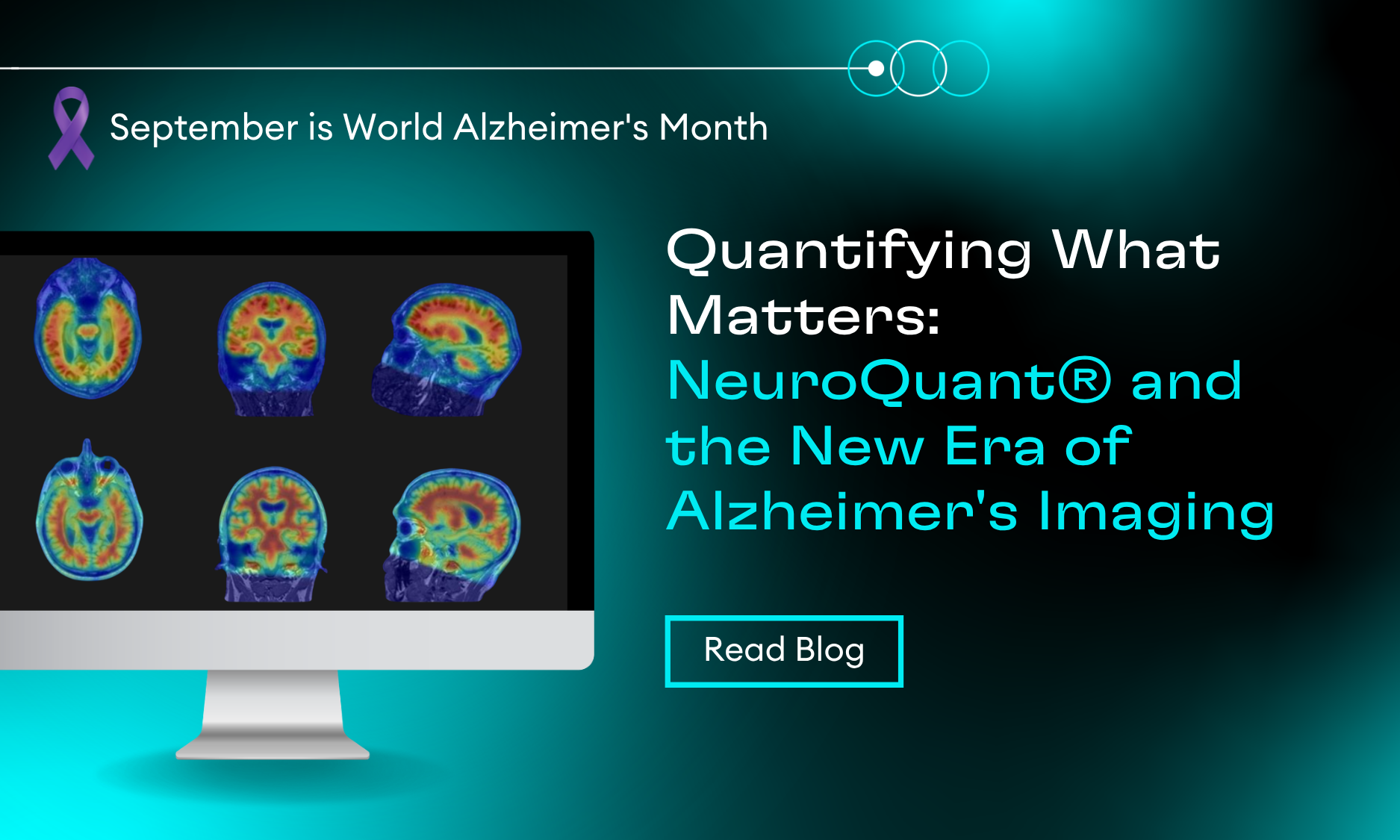
World Alzheimer’s Awareness Month is a time to reflect on the challenges of this devastating condition and the innovations that are shaping how we diagnose, monitor, and treat it. One of the most powerful shifts in recent years has been the move from subjective imaging assessments toward objective, automated brain volumetry.
NeuroQuant, an FDA-cleared software for automated MRI volumetric analysis, is at the forefront of this change. By providing reproducible measurements of key brain structures, it equips clinicians and researchers with data that can support earlier recognition of disease, track progression, and evaluate treatment efficacy.
Supporting Diagnosis and Early Detection
Early diagnosis remains one of the greatest challenges in Alzheimer’s care. Traditionally, radiologists rely on visual rating scales like the Medial Temporal Atrophy (MTA) score, but these are subjective and vary with expertise.
Recent studies (Persson 2018, Persson 2024, Essien 2023) have shown that NeuroQuant hippocampal volumetry correlates strongly with visual ratings while often achieving higher diagnostic accuracy. For example, NeuroQuant hippocampal volume reached an AUC of 0.80 for distinguishing dementia from non-dementia — outperforming visual MTA ratings. While NeuroQuant alone does not establish a diagnosis, it provides clinicians with reproducible, quantitative evidence that can support decision-making in memory clinic populations where every month counts.
Monitoring Disease Progression
Tracking disease trajectory is essential in both research and clinical settings. NeuroQuant allows longitudinal tracking of hippocampal and whole-brain volumes, providing a reliable measure of ongoing neurodegeneration.
Amland and colleagues (2024) demonstrated that baseline NeuroQuant hippocampal and global brain volumes predicted which patients with mild cognitive impairment or subjective decline would convert to dementia. Smaller volumes were also linked to faster deterioration on the Clinical Dementia Rating Sum of Boxes (CDR-SB). These findings highlight NeuroQuant’s role as a prognostic support tool helping clinicians identify higher-risk patients and intervene earlier in the disease course.
Assessing Treatment Response
With disease-modifying therapies on the horizon, imaging biomarkers are critical for evaluating whether treatments truly slow neurodegeneration. NeuroQuant has already been used in this role.
In a 2021 (Kile et al.) randomized controlled trial of intravenous immunoglobulin (IVIG) for prodromal AD, NeuroQuant quantified changes in ventricular volume over time. At one year, patients receiving IVIG showed significantly less brain atrophy compared to placebo, a signal not captured by clinical scores alone. While this effect was not sustained long-term, the trial demonstrated how NeuroQuant can provide an objective, supportive measure of therapeutic impact in Alzheimer’s clinical research.
Bridging Clinical Practice and Research
Perhaps the most important contribution of NeuroQuant is its ability to bridge the research-clinic divide. Automated volumetry reduces reliance on expert neuroradiologists, ensures reproducibility across imaging centers, and provides standardized data that can be directly integrated into clinical workflows and multi-site trials.
As studies repeatedly show, NeuroQuant delivers objective, accessible, and clinically meaningful data that complements but does not replace expert clinical judgment. Its adoption represents a major step toward precision imaging in dementia care.
Takeaway for Alzheimer’s Awareness Month
Alzheimer’s disease continues to impose a tremendous burden on patients, families, and healthcare systems. But tools like NeuroQuant are helping shift the paradigm. From supporting earlier recognition to monitoring progression and evaluating treatment impact, NeuroQuant provides objective insights that are advancing both clinical care and research.
As we recognize Alzheimer’s Awareness Month, it’s clear that automated imaging tools like NeuroQuant are not just innovations, they are becoming essential support tools in the fight against this disease, helping clinicians bring precision and consistency to Alzheimer’s care.
References
- Persson K, Braekhus A, Selbaek G, et al. Comparison of automated volumetry of the hippocampus using NeuroQuant® and visual assessment of the medial temporal lobe in Alzheimer’s disease. Acta Radiol. 2018;59(7):886-893.
- Persson K, Brækhus A, Selbæk G, et al. Diagnostic validity of regional brain volumes using NeuroQuant compared to visual rating scales in dementia. Brain Behav. 2024;14(2):e3397.
- Essien M, Kluger B, Liu W, et al. Automated hippocampal volumetry versus structured visual rating scales for Alzheimer’s disease, mild cognitive impairment, and subjective cognitive decline. AJNR Am J Neuroradiol. 2023;44(12):1411–1417.
- Amland RC, Nordby LM, Stensvold D, et al. Automated MRI volumetry predicts cognitive decline and conversion to dementia in patients with mild cognitive impairment and subjective cognitive decline. Front Neurol. 2024;15:1425502.
- Kile SJ, Haggerty G, Graham S, et al. Intravenous immunoglobulin therapy in prodromal Alzheimer’s disease: a randomized controlled trial with NeuroQuant volumetry. BMC Neurosci. 2021;22:49.