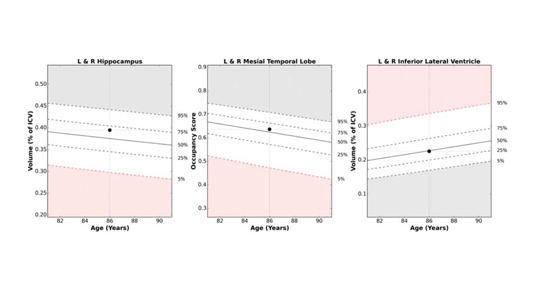
RSNA always offers a clear snapshot of where radiology is heading, and this year had a few themes: AI showing up in almost every conversation, a stronger push toward precision and patient-specific care, and a desire to make everyday workflows run more smoothly. Those ideas came through in nearly every discussion at the Cortechs.ai booth. Whenever quantitative imaging or structured reporting came up, people immediately recognized the challenge of reader variability and the value of objective data. The need hasn’t faded. If anything, it felt more present than ever.
One of the most surprising parts of the week was how many visitors already knew NeuroQuant. Our go-to question is, “have you heard of NeuroQuant?”. Hearing, “yes, of course” again and again set the tone for how clinically relevant and renowned our software is! The booth was full of familiar names and returning customers. What stood out most was how openly people shared how they use our tools and what they’d love to see next.
Although our portfolio is expansive, 3 products sparked the strongest reactions: NeuroQuant Brain Tumor, NeuroQuant CT, and OnQ Prostate. NeuroQuant Brain Tumor continues to impress clinicians with accurate tracking across multiple tumor types (including gliomas, mets, and meningiomas). NeuroQuant CT conversations often started with curiosity, but ended with genuine excitement once people saw how subtraction maps highlight subtle changes they worry about missing. OnQ Prostate delivered its usual moment of clarity when visitors saw the before-and-after images and immediately understood the clinical impact of improving conspicuity of clinically significant prostate lesions.
The booth itself kept a steady, warm energy throughout the week. People lingered, asked thoughtful questions, and connected with our team without feeling rushed. With 10 booth presentations running, there was always something to learn, and even people just passing by could catch a glimpse of something useful. The demos created a lot of “now I see it” moments, whether it was a lesion map, a longitudinal view, or a visualization. Radiologists asked about input sequences, workflow fit, and scan volume, which gave us the chance to explain the model and talk through real-world setup questions. And, on a lighter note, seeing old friends, meeting new ones, and stopping by the Bark Park each day kept the team in great spirits.
Across the week, certain clinical challenges kept resurfacing. Neuroradiologists aren’t thrilled about counting metastases or lesions manually, and tools like NeuroQuant MS and NeuroQuant Brain Tumor clearly helped address that. Interest in longitudinal tracking also came through in almost every conversation, and our brain metastasis quantification model got steady attention for the same reason. Many clinicians mentioned wanting the ability to review or edit segmentation results and reports, and that feedback is already guiding the updates we’re prioritizing for 2026. Conversations about reimbursement were more active this year as well, giving us a clearer sense of where education and support will matter most.
If there was one overall takeaway from RSNA 2025, it’s that clinicians are ready for tools that reduce manual work and make reporting more consistent. The conversations at our booth didn’t just validate demand. They helped clarify what the field needs next – and that direction is already shaping the year ahead.