London set the stage for one of the most consequential Alzheimer’s Association International Conference (AAIC) meetings in recent memory. From July 12–16, more than 13,000 researchers and clinicians from 111 countries gathered. Our team came away with a clear read on where the field is heading, and it maps directly onto the problems our NeuroQuant tools were built to solve.
Here are the themes that dominated the halls, and what they mean for the radiologists, neurologists, and imaging centers we work with every day.
Blood biomarkers are moving to the front of the funnel
If AAIC 2025 hinted at it, AAIC 2026 confirmed it: plasma p-tau217 is ready to change how Alzheimer’s disease is identified. In a large real-world Swedish study, knowing a blood test result helped primary care physicians diagnose Alzheimer’s with nearly the same accuracy as specialists. Other data suggested p-tau217 may flag risk of cognitive decline five to ten years before symptoms appear, and Eli Lilly presented assay performance that rivals amyloid PET for ruling in pathology.
The takeaway is that blood tests will pull far more patients into the diagnostic pathway, and that raises the stakes for what happens next. A positive blood test is a signal, not a diagnosis. Confirming amyloid status, staging neurodegeneration, and establishing a treatment baseline still require imaging. As the top of the funnel widens, the downstream demand for standardized, confirmatory imaging grows with it.
NeuroQuant delivers AI-driven volumetric analysis of memory-associated structures and compares each measurement against an age- and gender-matched normative database. When a blood test raises the question, volumetry helps answer it: Is there measurable neurodegeneration yet? Does the atrophy pattern point toward Alzheimer’s versus frontotemporal dementia? All without added scan time.
The disease-modifying therapy era is now a real-world story
Anti-amyloid therapies were no longer a “what if” at AAIC 2026 — they were a “what’s actually happening.” An interim analysis of the real-world LEADER study showed more than 80% of early Alzheimer’s patients treated with lecanemab remained clinically stable or improved over an average of 17 months. New donanemab data addressed safety through modified titration and corticosteroid pretreatment, and we saw the first real-world data on at-home subcutaneous autoinjector use.
More patients on therapy means more imaging responsibility for the radiologist — both to establish eligibility and to monitor safety. This is where NeuroQuant Lesion Surveillance earns its place in the workflow. Its FDA-cleared capabilities support:
• Pre-treatment eligibility screening, through quantification of microhemorrhages on GRE or SWI sequences at baseline and providing a Fazekas score on FLAIR.
• ARIA surveillance during treatment — quantifying intracranial blood products and interval change related to ARIA-H (microhemorrhage, superficial siderosis), and identifying and measuring new FLAIR hyperintensity related to ARIA-E (edema, sulcal effusion).
These features support the radiographic grading of ARIA, one of the most repetitive and consequential monitoring tasks.
Standardization was the quiet throughline
Across sessions on blood tests, PET, and MRI, the same word kept surfacing: standardization. The field wants scalable, reproducible, objective measures that travel well between primary care, radiology, nuclear medicine, and neurology — and that hold up across sites and over time. The excitement about blood tests is, at its core, excitement about accessibility and consistency. The same logic applies to imaging.
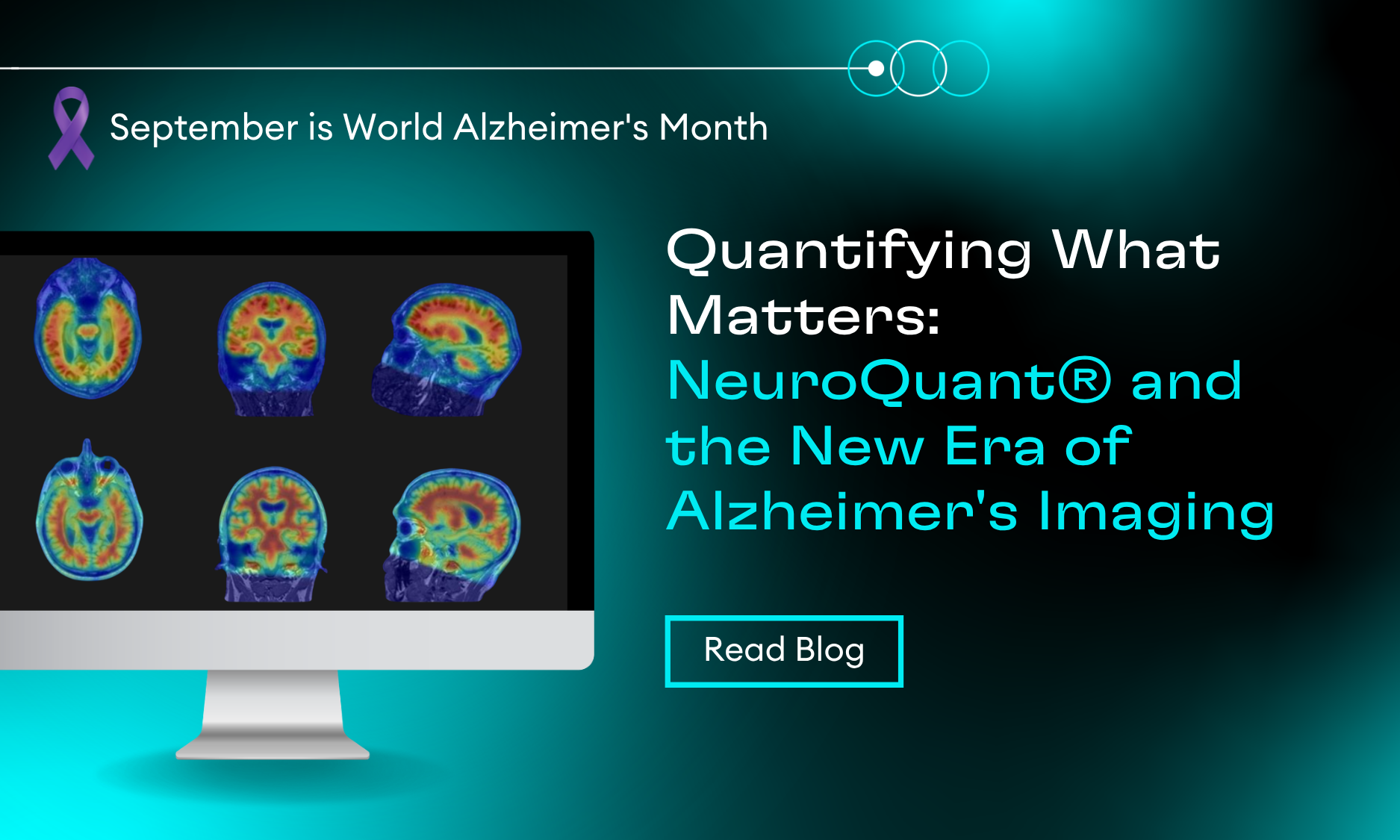
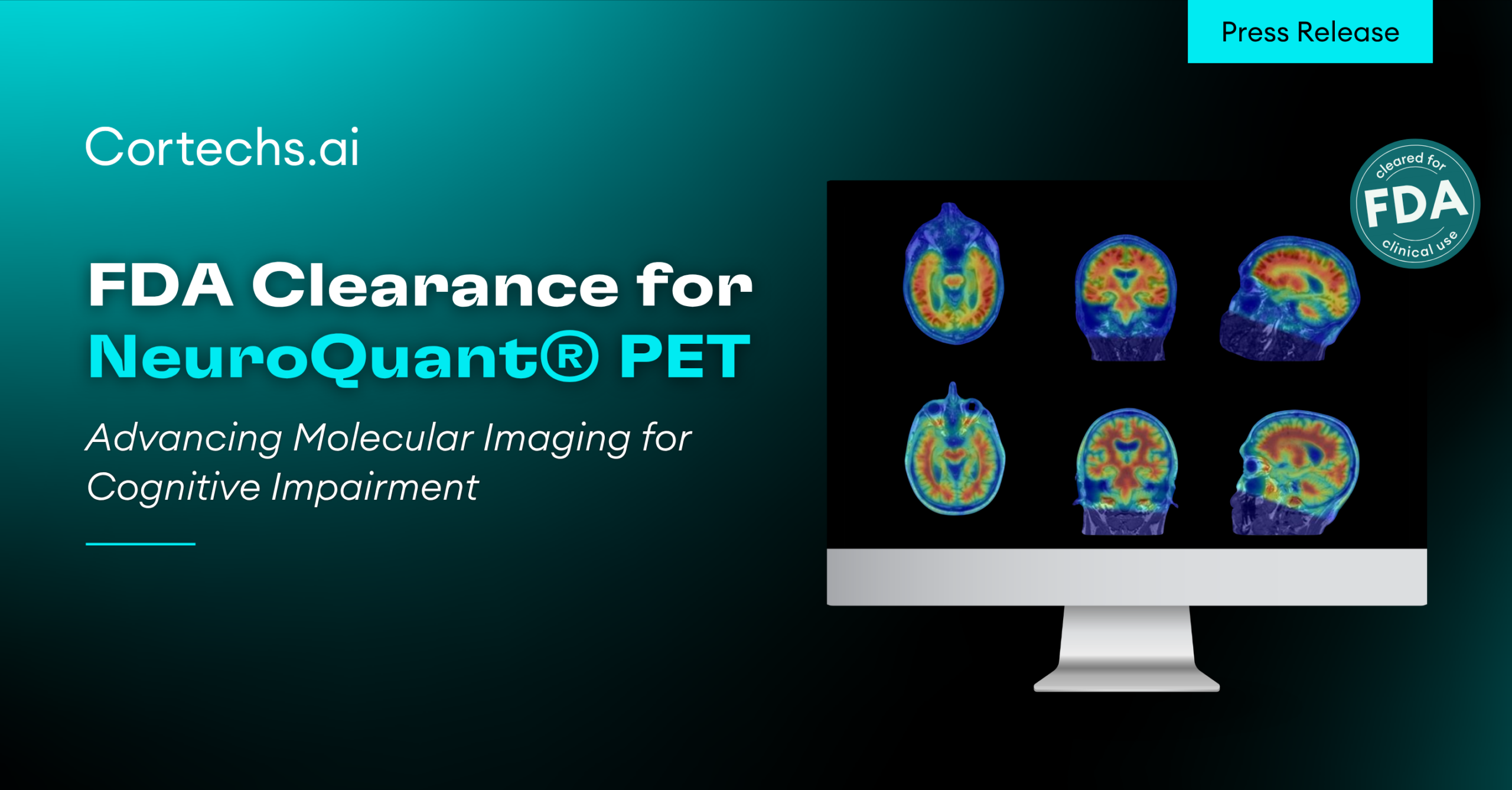
Quantification is how imaging meets that bar. Automated analysis reduces inter-reader variability and produces the kind of objective, comparable numbers that multidisciplinary teams can actually align around. On the molecular side, NeuroQuant PET (FDA 510(k)-pending) brings that same discipline to amyloid, tau, and FDG studies: it automatically quantifies tracer binding localized to brain structures, reports regional SUVR and z-scores against normative data, and generates Centiloid values that make amyloid burden comparable across tracers — florbetapir, florbetaben, flutemetamol — and across time. For a clinician confirming amyloid positivity before initiating therapy, or tracking amyloid clearance during it, a single standardized number is worth more than a subjective read.
Early detection remains the whole ballgame
Finally, AAIC reinforced what the CLARITY AD trial made clear: the earlier therapy begins, the greater the benefit. Amyloid may accumulate decades before symptoms, but tau deposition and measurable atrophy tend to co-emerge as cognitive decline begins — which makes volumetric MRI a valuable subclinical biomarker for catching disease at its most treatable stage. When tau PET isn’t reliably available or reimbursed, quantitative volumetry helps identify the patient who is amyloid-positive and symptomatic but still has preserved brain volumes: exactly the patient a DMT is designed to help.
The takeaway for our customers
AAIC 2026 clarified imaging’s role. Blood tests will identify more candidates. Therapies will put more patients under active management. And every one of those patients will need confirmation, baseline characterization, and ongoing, standardized monitoring. That is the work quantitative imaging does best.
Whether it’s volumetric MRI for atrophy and ARIA, or molecular PET quantification with Centiloid scoring, the NeuroQuant suite is built to bring clarity and consistency to each step of the Alzheimer’s care continuum — from the first cognitive concern through the full treatment journey.
NeuroQuant® PET is FDA 510(k)-pending and is currently available for research use only.