The McDonald Criteria and Quantitative MRI from the Start
Magnetic resonance imaging (MRI) has long served as the foundation for diagnosing and monitoring multiple sclerosis (MS). The McDonald criteria, first introduced in 2001 and revised multiple times since, formalize how clinical findings and MRI evidence are combined to establish a diagnosis by demonstrating dissemination of disease in both space and time. These criteria have enabled earlier diagnosis and treatment initiation, improving outcomes for people living with MS. As imaging capabilities have advanced, the criteria have continued to evolve, with proposed 2024 revisions further emphasizing the central role of MRI and quantitative imaging biomarkers in MS care.
At their core, the McDonald criteria rely on two MRI-based concepts. Dissemination in space (DIS) is demonstrated by the presence of lesions in characteristic central nervous system locations, including periventricular, juxtacortical or cortical, infratentorial, and spinal cord regions. Dissemination in time (DIT) is demonstrated by evidence of ongoing disease activity, such as the coexistence of enhancing and non-enhancing lesions or the appearance of new or enlarging lesions on follow-up imaging.
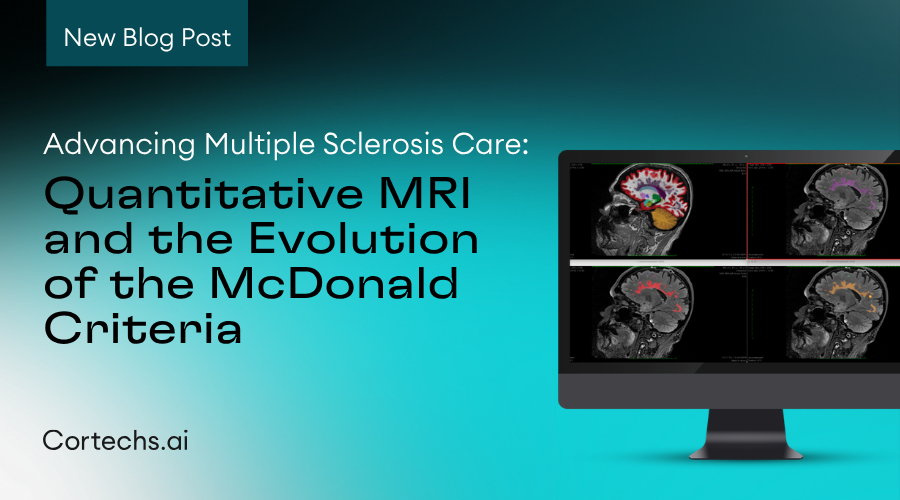
From its market release, NeuroQuant MS was designed to align with these diagnostic requirements by providing automated, quantitative MRI outputs that directly support assessment of both DIS and DIT. The software automatically identifies T2 FLAIR lesions, classifies them by anatomical location relevant to the McDonald criteria, and quantifies lesion counts and volumes across regions. In addition, longitudinal comparisons between current and prior scans identify new, enlarging, shrinking, and stable lesions, enabling objective assessment of disease activity over time. By standardizing lesion detection, classification, and longitudinal tracking, NeuroQuant MS has supported reproducible MRI-based decision-making in MS from the outset.
Emerging MRI Biomarkers in MS and Challenges to Clinical Implementation
While the traditional MRI features used in the McDonald criteria have improved diagnostic sensitivity, they are not fully specific to MS. White matter lesions may also be seen in vascular, inflammatory, or age-related conditions, motivating the search for imaging biomarkers that more closely reflect MS-specific pathology. The proposed 2024 revisions to the McDonald criteria highlight this shift by drawing attention to emerging MRI biomarkers that may improve diagnostic specificity and disease characterization, particularly the central vein sign (CVS) and paramagnetic rim lesions (PRLs).
The central vein sign reflects a hallmark pathological feature of MS: inflammatory demyelination occurring around small veins. On MRI, CVS appears as a vein running through the center of a white matter lesion. Detection of the central vein sign typically relies on high-resolution imaging techniques, including FLAIR-based sequences, susceptibility-based imaging, or combined FLAIR* methods. Multiple studies indicate that when a majority of lesions demonstrate the central vein sign, the likelihood of MS is substantially higher than that of other white matter disorders.
Despite its promise, clinical implementation of CVS faces several challenges. Detection often requires advanced MRI sequences that may not be uniformly available across imaging centers. Visual identification can be subjective, and consistent lesion-level assessment is difficult to achieve without standardized methods.
Paramagnetic rim lesions represent another emerging biomarker with important implications for MS care. PRLs correspond to chronic active lesions characterized by iron-laden microglia and macrophages at the lesion edge. On MRI, these lesions appear as a hypointense rim on susceptibility-sensitive sequences such as T2*, susceptibility-weighted imaging, or quantitative susceptibility mapping. Research suggests that PRLs may be associated with more aggressive disease and greater disability progression.
As with CVS, the routine clinical use of PRLs is constrained by technical and practical challenges, including sequence availability, reader expertise, and inter-reader variability, particularly for longitudinal assessment.
Quantification Software and the Future of MS Care
As MS imaging moves toward a more quantitative and biomarker-driven paradigm, the volume and complexity of MRI data continue to increase. Purely qualitative interpretation becomes increasingly insufficient for capturing subtle disease activity, monitoring progression, or integrating emerging biomarkers into clinical decision-making.
NeuroQuant MS addresses this need by providing standardized, automated lesion detection, volumetric analysis, and longitudinal disease tracking within a clinically accessible workflow. By quantifying lesion burden and objectively identifying changes over time, the platform improves reproducibility across readers and imaging centers while reducing reliance on subjective visual assessment.
As imaging biomarkers such as the central vein sign and paramagnetic rim lesions gain recognition, reliable tools will be required to detect, quantify, and track these features consistently. Future enhancements to NeuroQuant MS aim to incorporate quantitative assessment of these emerging markers, supporting both large-scale research and eventual clinical adoption. Ultimately, platforms such as NeuroQuant MS help translate advanced MRI biomarkers into clearer, more confident decisions for diagnosis, treatment planning, and long-term disease management.